olivier godechot
2024-05-28 | Ten toots on the making of economists
A copy/paste of my Mastodon/X thread which pays a tribute to the research of my former PhD student, Pablo Zamith, on the making of economists.
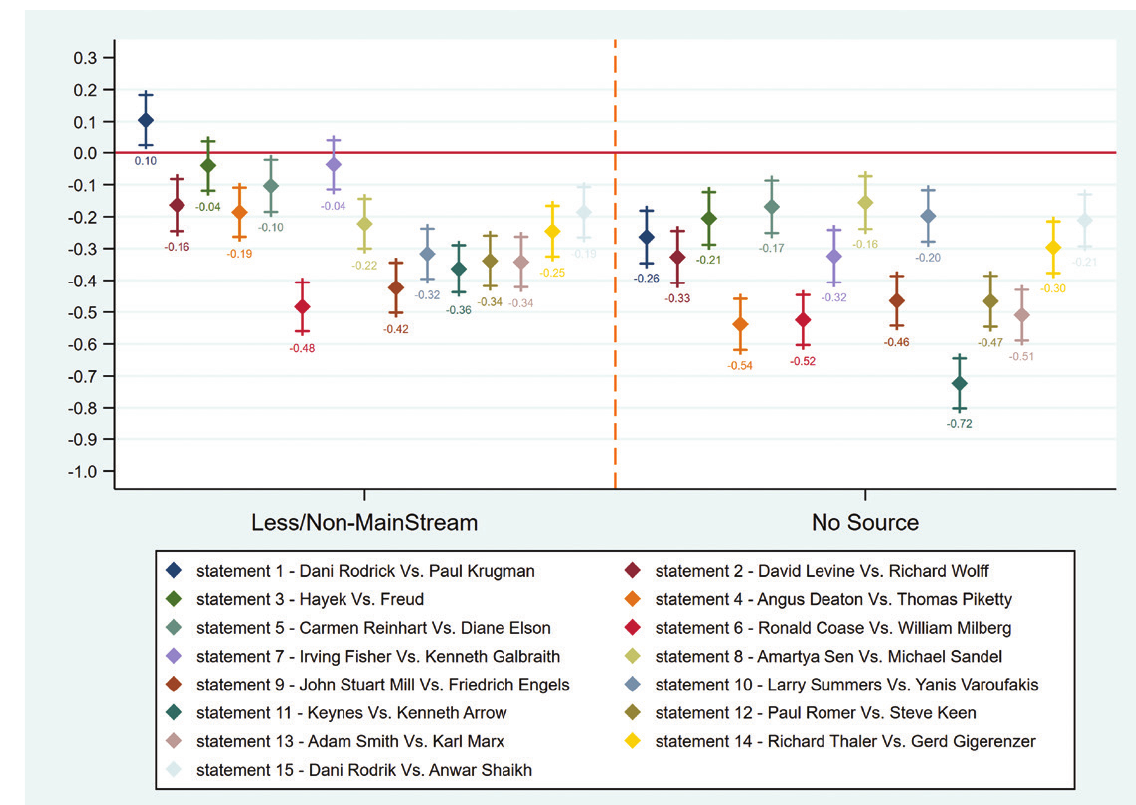
Thanks to François Geerolf, I have recently discovered Javdani & Chang’s 2023 experiment https://academic.oup.com/cje/article/47/2/309/7084598, which shows that economists are more likely to agree with a given statement if the author is identified as mainstream. 1/N
It has reminded me of the fascinating work of my former sociology PhD student, Pablo Zamith, who unfortunately left the PhD program before completion. In 2016-2017, he ran a similar survey experiment among 600+ master students at the prestigious Toulouse School of Economics. 2/N
He did not publish his work and I kept only a few slides from his oral presentations, which I reread with thrill. Despite some imprecision on the design, I have been able to reconstitute the main findings and make them public, as they may be useful to the community 3/N.
1. Like (and before) Javdani & Chang’s 2023, he also tested symbolic authority of economists by asking on a 0-100 scale whether students agreed with a classical mainstream statement, justified by a quote whose authorship was attributed to various authors. 4/N
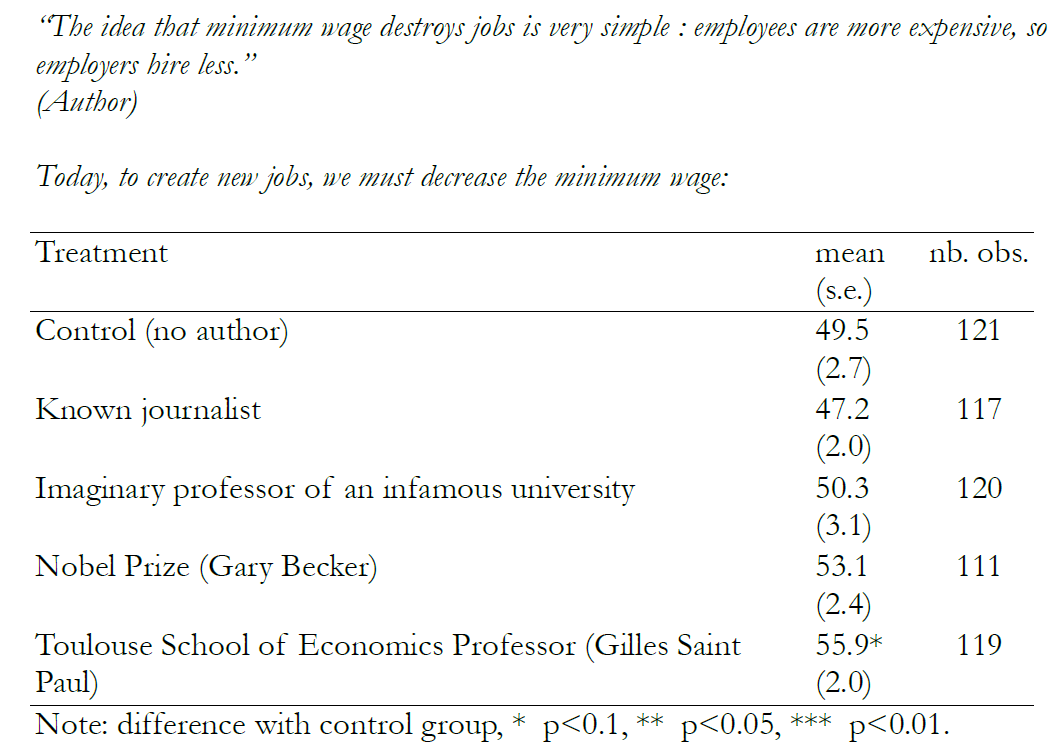
This first experiment showed that economics students are sensitive to the local authority (1/5 of a Standard Deviation), and to some extent, not statistically significant here, to the symbolic authority of a Nobel prize (12% of a SD), as in Javdani & Chang (2023). 5/N
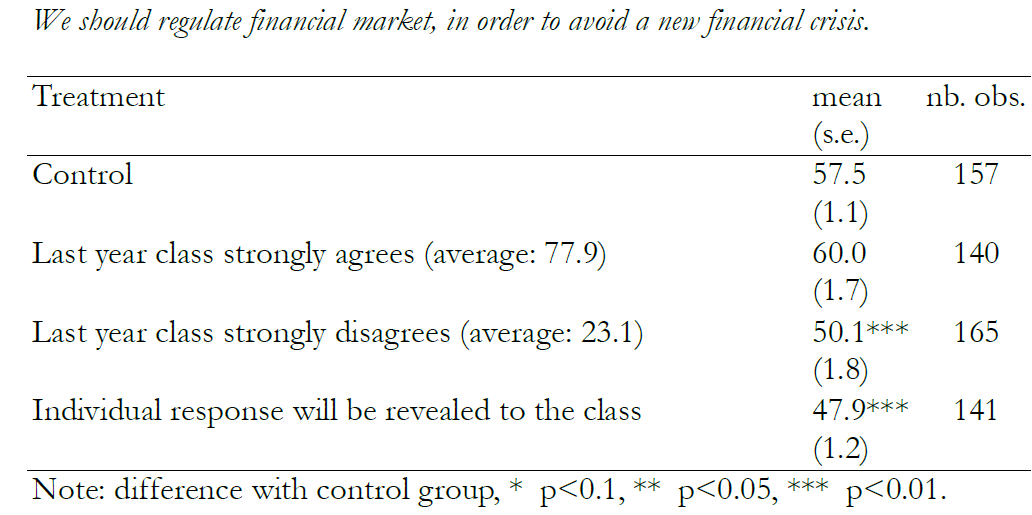
2. But he also tested the effect of peer pressure. When told previous year cohort disagreed (with a "heterodox" view), or moreover, when told they had to reveal their choice, students opt for a more mainstream view maybe as a safe strategy, as if they wanted to avoid being caught with the wrong view. 6/N
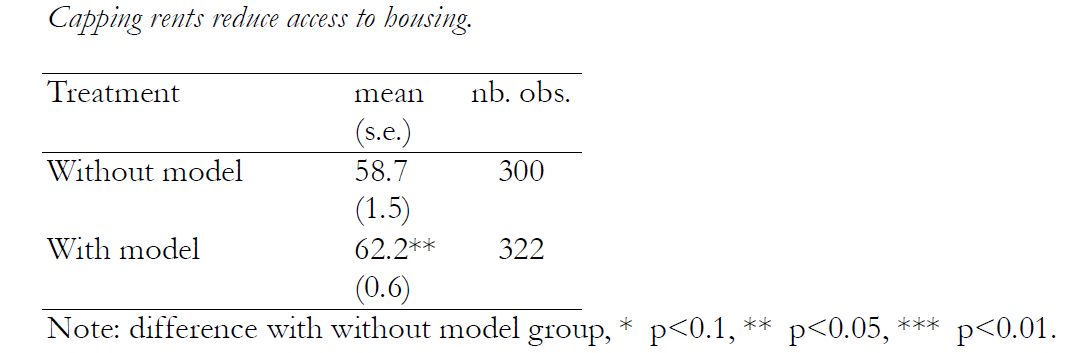
3/ Finally, he also tested the existence of mathematical domination by examining whether the presence or absence of the following mathematically inspired diagram changed agreement with a given statement. 7/N
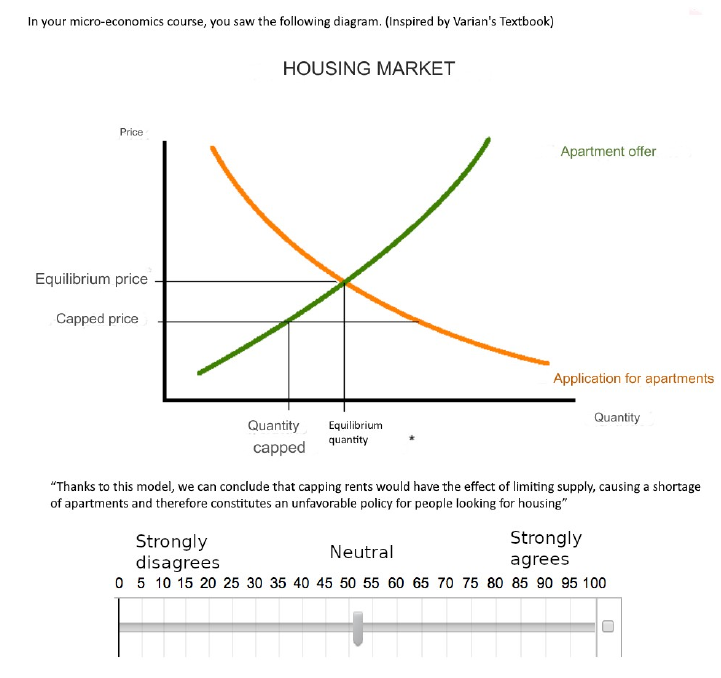
This last experiment provides an experimental evidence of the role of mathematics in enforcing the legitimacy of a given economic statement. Here, the presence of the mathematical diagram increases agreement by 13% of a standard deviation. 8/N
Of course, economics is not the sole discipline in which symbolic authorities, peer pressure, and mathematical domination play a strong normative role. And up to a point, this symbolic pressure can play a functional role, allowing entrants to adopt a better informed view. 9/N
However, because economics has pushed its sense of superiority (Fourcade et al. 2015), its internal hierarchy and its religion of a unidimensional “excellence” so far (and probably much further than any other discipline), it may also inhibit critical examination of alternative views. N/N


OgO: plus ici|more here
[Livres] Palier, Bruno et al.. 2023. Que sait-on du travail?, [What do we know about work?], Presses de Sciences ...: plus ici|more here
[Articles revus par les pairs] Godechot, Olivier, Donald Tomaskovic-Devey, István Boza, Lasse Folke Henriksen, Are Skeie Hermansen, Feng Hou, Jiwook Jung, Naomi Kodama, ...: plus ici|more here
[Documents de travail] Neumann, Nils, Olivier Godechot, Lasse Folke Henriksen, Are Skeie Hermansen, Feng Hou, Naomi Kodama, Zoltán Lippényi, Silvia Maja Melzer, ...: plus ici|more here
[Données] Data and scripts for Les fissures de la digue républicaine In our article "Les fissures de la digue républicaine" (in ...: plus ici|more here
[Données] Replication package for the Great Separation The Great Separation is based on fine-grained administrative data that cannot be published ...: plus ici|more here
[Publications] 2025 Neumann, Nils, Olivier Godechot, Lasse Folke Henriksen, Are Skeie Hermansen, Feng Hou, Naomi Kodama, Zoltán Lippényi, Silvia Maja ...: plus ici|more here


HOP
A CMS